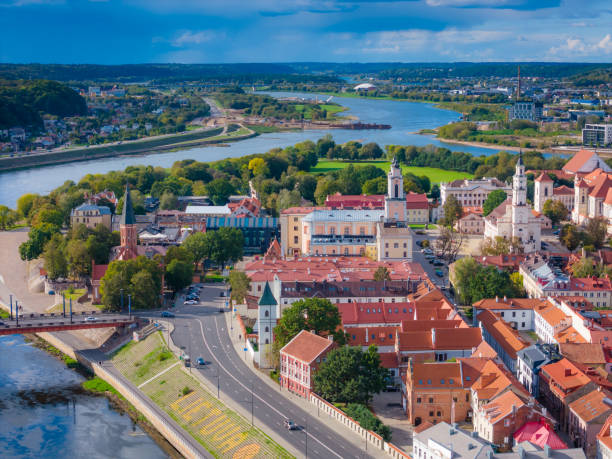
How is the Baltic Nation of Lithuania Becoming One of Europe’s Most Competitive Digital Finance Hubs?
A decade ago, few would have predicted that Lithuania would become one of Europe’s most active fintech destinations. Today, however, international fintech firms looking to establish a presence within the European Union (EU) increasingly find themselves examining Vilnius alongside cities such as Amsterdam, Dublin, Berlin and Luxembourg. What was once viewed as a relatively small Baltic economy has evolved into one of Europe’s most dynamic financial innovation ecosystems.
The transformation did not happen by accident. Lithuania’s fintech success is the result of a deliberate strategy that combined regulatory agility, digital infrastructure, entrepreneurial talent and close cooperation between policymakers, regulators and the private sector. While many countries have spoken about becoming fintech hubs, Lithuania spent the past decade creating the conditions necessary to make it happen.
The results are increasingly visible. According to Invest Lithuania and the Bank of Lithuania, the country is now home to more than 270 fintech companies, making it one of the largest fintech ecosystems in the European Union (EU) relative to its population size. The sector employs thousands of professionals and continues to attract both startups and established international firms.
What makes this achievement particularly noteworthy is the country’s size. Lithuania has a population of fewer than three million people and an economy that remains modest compared to Western Europe’s larger markets. According to the World Bank, gross domestic product (GDP) per capita now exceeds $31,000, supported by sectors including financial services, manufacturing, technology, logistics, life sciences and business services.
Vilnius serves as the country’s financial and technology centre. Over recent years, the city has increasingly developed a reputation as one of Central and Eastern Europe’s leading startup hubs, attracting entrepreneurs, investors and international companies looking for access to European markets.
A key turning point came following Brexit. As fintech firms sought continued access to the EU’s single market, Lithuania positioned itself as an attractive alternative location. The Bank of Lithuania responded by streamlining licensing processes and creating a regulatory environment designed to encourage responsible innovation.
This approach helped attract firms that needed European regulatory access while maintaining operational flexibility.
Today, the Bank of Lithuania is widely regarded as one of Europe’s more innovation-oriented financial regulators. Through initiatives such as its Newcomer Programme, the central bank provides guidance and support to companies seeking to establish regulated financial operations in the country.
The regulator has also invested heavily in infrastructure.
One example is CENTROlink, the Bank of Lithuania’s payment system that provides access to the Single Euro Payments Area (SEPA). This infrastructure allows licensed payment institutions and electronic money institutions to connect directly to European payment systems without relying solely on commercial banks.
For fintech companies, this can significantly reduce barriers to entry. The importance of payments within Lithuania’s ecosystem cannot be overstated.
The country has become particularly attractive for payment institutions, electronic money providers and digital banking firms. According to the Bank of Lithuania, the country hosts one of the largest concentrations of licensed electronic money institutions within the European Union.
This specialisation has helped create a cluster effect. As more payment firms establish operations, they attract talent, service providers, compliance specialists and technology partners, reinforcing the ecosystem’s growth.
Several notable companies illustrate this development. Lithuanian-founded fintechs such as ConnectPay, Kevin and Paysera have gained recognition for their payment services and open banking solutions. Kevin, in particular, has emerged as one of Europe’s more prominent account-to-account payment providers, benefiting from the growth of open banking infrastructure across the continent.
Open banking itself has become a major theme within Lithuania’s fintech ecosystem.
The implementation of PSD2 created opportunities for firms to build services around payment initiation, account aggregation and financial data. Lithuania’s regulatory environment and digital-first culture allowed many companies to embrace these opportunities early.
As Europe moves towards broader open finance initiatives, Lithuanian fintech firms could find themselves well-positioned to benefit from additional data-sharing frameworks.
Yet payments represent only one part of the story. The country’s fintech ecosystem has expanded into lending, regtech, wealthtech, insurtech and digital banking. International firms such as Revolut selected Lithuania as the location for their European banking licence, further strengthening the country’s reputation within the sector.
Revolut’s decision proved particularly influential. It demonstrated that major fintech firms viewed Lithuania not merely as a regional market, but as a credible jurisdiction from which to serve customers across Europe.
The country’s digital foundations have also contributed significantly to fintech growth. Lithuania consistently ranks highly in areas such as connectivity, digital skills and online public services. According to the European Commission’s Digital Economy and Society indicators, the country has made considerable progress in digitalisation, creating an environment where both consumers and businesses are comfortable using digital services.
This digital readiness extends into financial services. Consumers increasingly use mobile banking, contactless payments and digital wallets, while businesses have embraced electronic invoicing, online payments and digital financial management tools.
Artificial intelligence (AI) is now emerging as the next frontier. The Lithuanian government’s AI strategy and broader innovation agenda increasingly recognise the role advanced technologies could play in future economic growth. Within financial services, AI applications are being explored across fraud detection, customer service, compliance monitoring and risk management.
The country is also seeking to strengthen its position in cybersecurity, another increasingly important area for fintech companies operating in highly regulated environments.
Of course, challenges remain. Lithuania’s domestic market is relatively small, which means most fintech firms must adopt international growth strategies from an early stage. Competition is intensifying as other European jurisdictions seek to attract fintech investment, while regulatory expectations continue to evolve through frameworks such as DORA and MiCA.
Maintaining access to specialised talent will also be important as demand for software engineers, compliance professionals and data scientists continues to rise.
Nevertheless, Lithuania enters this next phase from a position of considerable strength.
Unlike some ecosystems that grew organically over time, Lithuania’s fintech sector reflects a coordinated effort involving regulators, policymakers, financial institutions and entrepreneurs. This collaboration has created an ecosystem that punches well above its weight within Europe.
What distinguishes Lithuania is not simply the number of fintech companies it hosts. It is the country’s ability to combine regulatory credibility, digital infrastructure and market access into a compelling proposition for international firms.
Ultimately, Lithuania’s fintech journey offers a valuable lesson for smaller economies.
Success in digital finance does not necessarily require a vast domestic market or a centuries-old financial centre. With the right combination of policy, infrastructure and ambition, even relatively small nations can become influential players within the global fintech landscape.