As Medicare’s open enrollment period for 2027 gets underway, Medicare beneficiaries have an opportunity to examine their coverage options and make changes. For Medicare Part D prescription drug coverage, the average beneficiary has 28 Medicare Advantage prescription drug plans (MA-PDs) and 9 stand-alone prescription drug plans (PDPs) to choose from, with varying costs associated with these different options. This analysis examines premiums and cost-sharing requirements for Part D coverage in 2027 and how these costs have changed over time, based on Medicare plan landscape and benefits data from the Centers for Medicare & Medicaid Services (CMS).
Takeaways
- The estimated average enrollment-weighted monthly premium for Medicare Part D stand-alone PDPs is projected to be $51 in 2027, a 50% increase from $34 in 2026 (based on June 2026 enrollment), assuming current enrollees keep their same plan for 2027. While CMS projected a modest $1 increase in the national average premium, from $35 to $36 (based on September 2026 enrollment), they did not explain the method used in the calculation. It’s possible CMS assumed switching to lower-cost plans, which would produce a lower enrollment-weighted average premium for 2027 than our estimate of $51, and it is likely that the actual average PDP premium for 2027 will be lower than $51 after accounting for plan choices by new enrollees and switching by current enrollees during open enrollment. If PDP enrollees who are not receiving Part D Low-Income Subsidies (LIS) keep their current plan in 2027, more than half (55% or 7.5 million) will pay premiums of less than $20 per month but nearly 30% (3.9 million) will pay at least $100 per month.
- Monthly premiums for drug coverage are estimated to be more than 5 times higher for PDPs compared to MA-PDs in 2027 – $51 versus $9. The average monthly Part D premium is projected to increase by $17 for PDPs but by less than $2 for MA-PDs. MA-PD sponsors can use rebate dollars from Medicare payments to buy down their Part D premiums, as well as provide extra benefits, but these funds are not available to sponsors for PDPs. The MA-PD premium is also heavily weighted by zero premium plans, with nearly 8 in 10 MA-PD enrollees paying no premium for drug coverage in 2026.
- Three-fourths of PDP enrollees without low-income subsidies (76% or 10.4 million) will pay a higher monthly premium in 2027 if they make no changes during open enrollment, compared to 56% of enrollees who faced a higher premium for their plan in 2026. This includes 4.1 million PDP enrollees without LIS who are enrolled in zero premium PDPs in 2026 and who will face higher premiums next year because no zero premium PDPs are available in 2027. Among the 10.4 million PDP enrollees facing a premium increase, 2.4 million will see their monthly premium increase by more than $50 if they stay in their same plan for 2027. By comparison, only 38,000 enrollees faced a premium increase larger than $50 per month in 2026. The Trump administration’s decision to discontinue the Part D Premium Stabilization Demonstration after 2026 ended the additional premium subsidies that were provided to PDP sponsors and the cap on the maximum allowable monthly PDP premium increase, which was set at $50 for 2026. (Monthly premiums could increase by more than $50 in 2026 for PDPs that did not participate in the demonstration.)
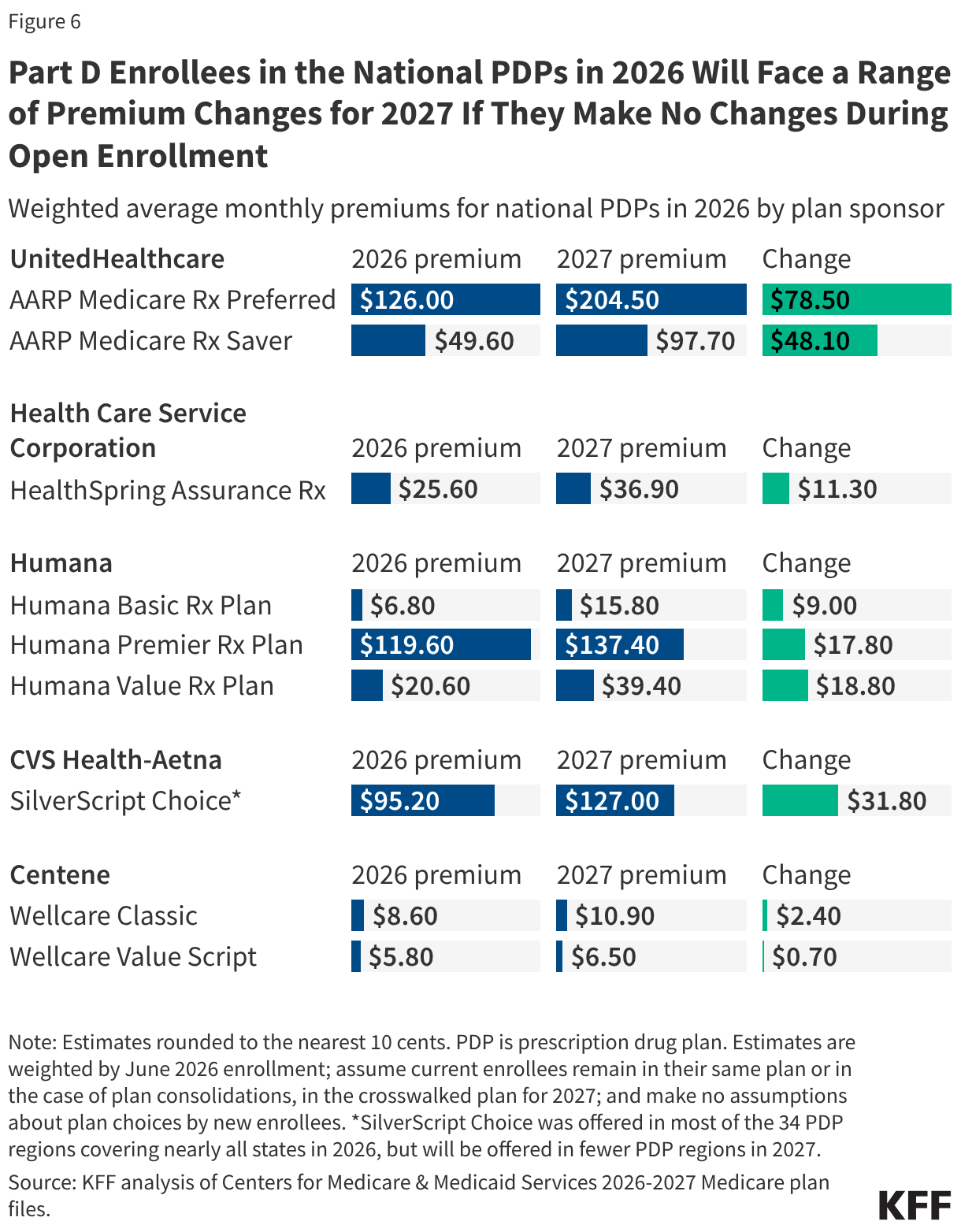
- Average monthly premiums for the 8 national PDPs are projected to range from around $6 to $204 in 2027. Among national PDPs, the two lowest-premium plans are Centene’s Wellcare Value Script Rx, an enhanced PDP with an average premium of $6.50 for 2027 (up from $5.80 in 2026) and Wellcare Classic, a basic PDP with an average premium of $10.90 for 2027 (up from $8.60 in 2026). The national PDPs with the highest average monthly premiums are United’s AARP Medicare Rx Preferred ($204.50, up from $126.00 in 2026) and Humana Premier Rx Plan ($137.40, up from $119.60 in 2026).
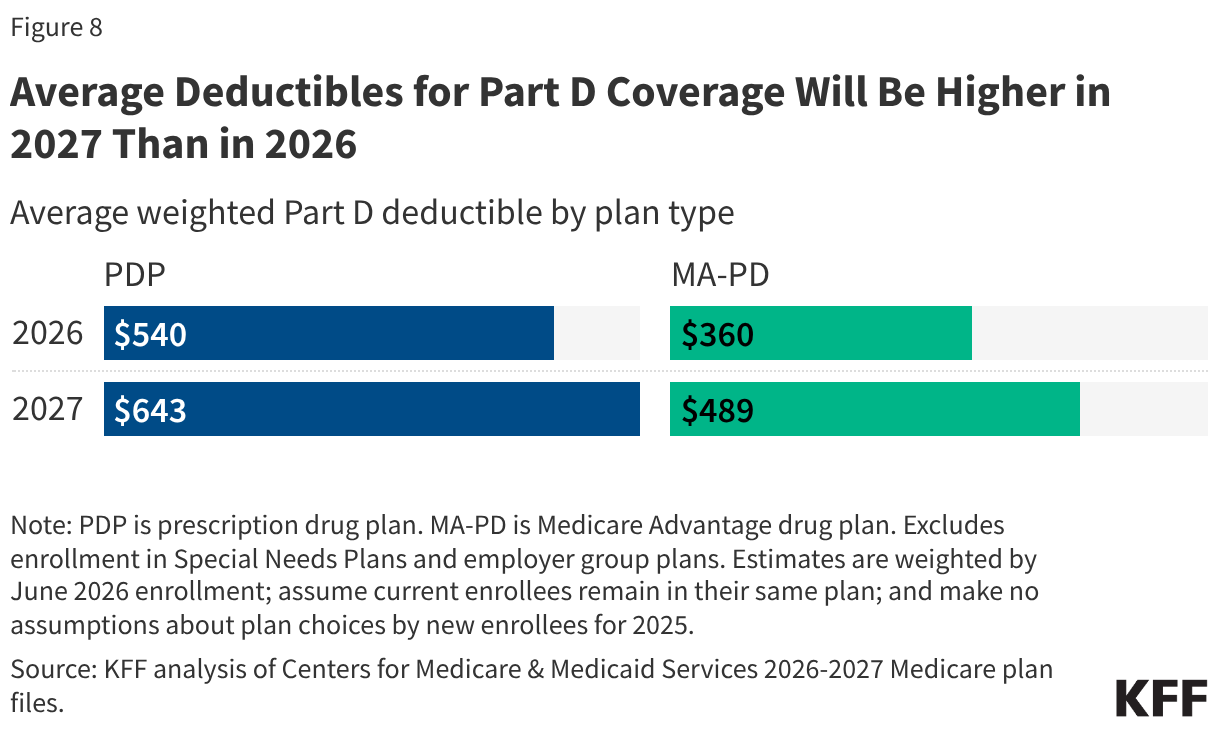
- Most Part D enrollees will face a deductible for drug coverage in 2027, including 85% of MA-PD enrollees (up from 80% in 2026) and virtually all PDP enrollees (99.8%, up from 96% in 2026), based on current enrollment. The average Part D deductible in 2027 will be $643 for PDP enrollees (up from $540 in 2026) and $489 for MA-PD enrollees (up from $360 in 2026). The standard Part D deductible in 2027 is $700, up from $615 in 2026.
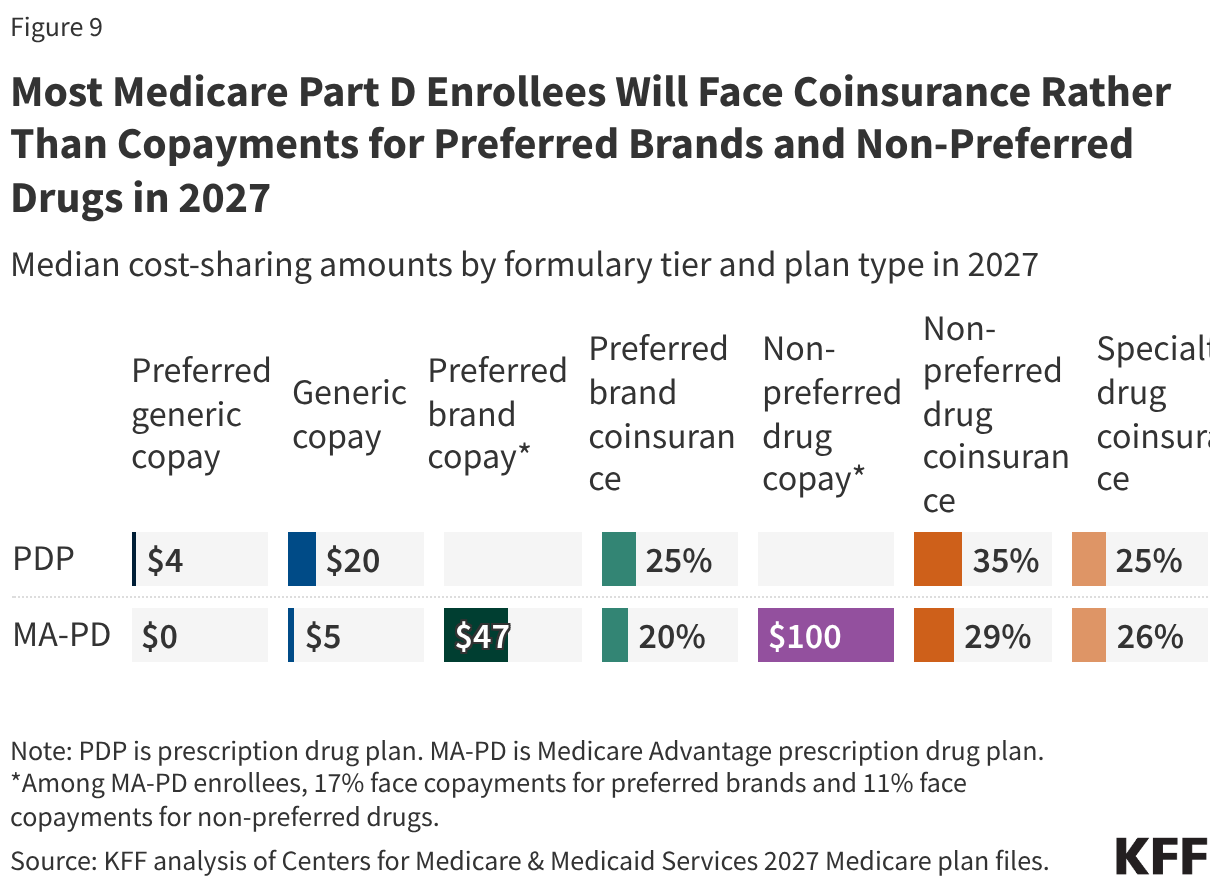
- Most Part D enrollees will face coinsurance rather than copayments for both preferred brands and non-preferred drugs, which can mean less predictable out-of-pocket costs. For preferred brands, most MA-PD enrollees (83%) will face median coinsurance of 20%, and virtually all PDP enrollees (99.8%) will face median coinsurance of 25%. For non-preferred drugs, 89% of MA-PD enrollees will face median coinsurance of 29% and all PDP enrollees will face median coinsurance of 35%. For 2027, the 50% of PDP enrollees enrolled in Centene’s Wellcare PDPs will face coinsurance of 15% for drugs on a new injectable drug tier. For specialty tier drugs (those that cost more than $1,080 per month), median coinsurance will be 25% for PDP enrollees and 26% for MA-PD enrollees.
Premiums
The Average Monthly Premium for Medicare Part D Stand-Alone PDPs Is Projected to Be $51 in 2027, a 50% Increase From $34 in 2026, Based on Current Enrollment
If PDP enrollees keep their current plan, the average monthly PDP premium will increase from $34 in 2026 to $51 in 2027. While CMS projected a modest $1 increase in the national average premium (from $35 to $36, based on September 2026 enrollment), they did not explain the method used in the calculation. It’s possible CMS assumed switching to lower-cost plans, which would produce a lower enrollment-weighted average premium for 2027 than our estimate of $51. After accounting for plan choices by new enrollees and switching by current enrollees during open enrollment, it is likely that the actual average PDP premium for 2027 will be lower than $51 (Figure 1).
For comparison, at the beginning of open enrollment in October 2025, the average monthly premium for PDP coverage was estimated to increase from $37 in 2025 to $44 for 2026, based on enrollment at that time, but after accounting for changes during open enrollment, the actual weighted average premium in 2026 was $34, as existing enrollees switched to and new enrollees joined lower-premium plans.
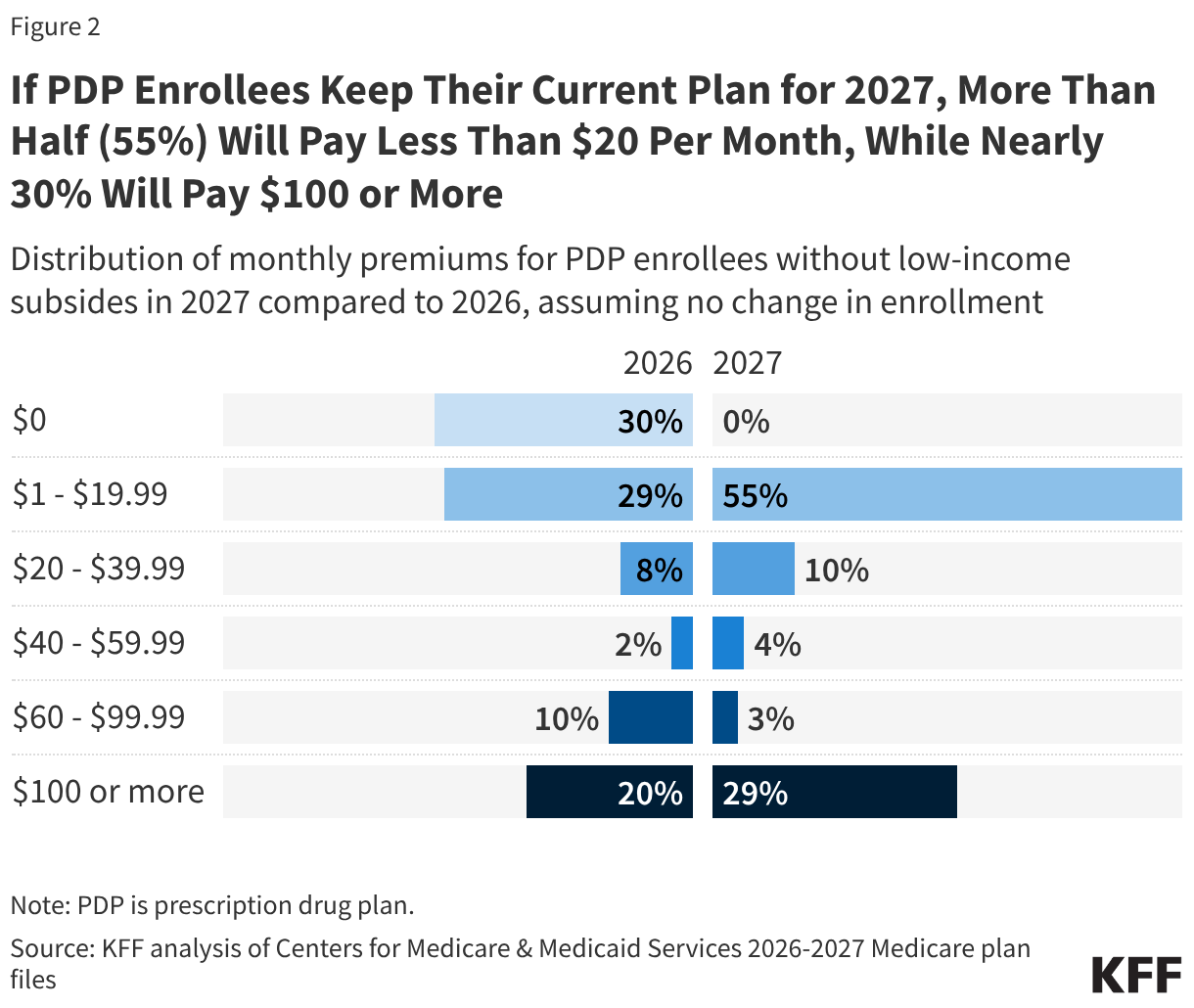
If the 13.6 million PDP enrollees without Part D Low-Income Subsidies (LIS) in 2026 keep their current plan for 2027, more than half (55% or 7.5 million) will pay premiums of less than $20 per month, but none will pay zero monthly premium and nearly 30% (3.9 million) will pay $100 per month or more. In 2026, 30% of these enrollees are paying zero monthly premium and 20% are paying $100 per month or more (Figure 2).
PDP Enrollees Will Pay Higher Monthly Premiums Than MA-PD Enrollees in 2027 – an Estimated $51 versus $9, on Average
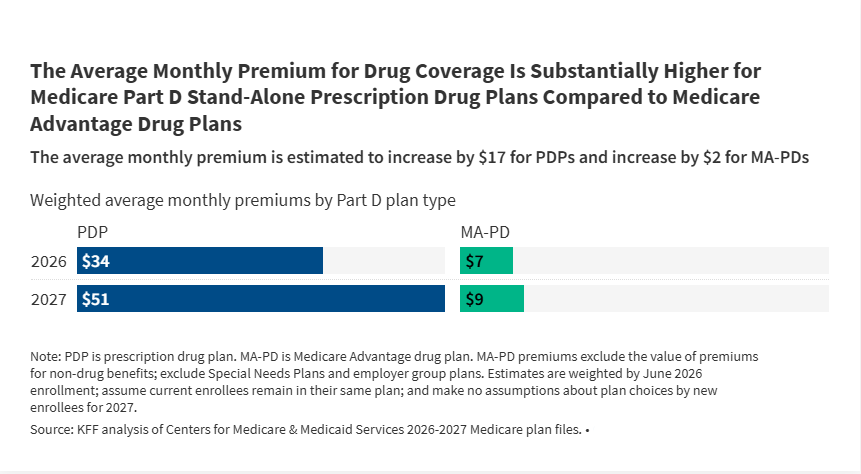
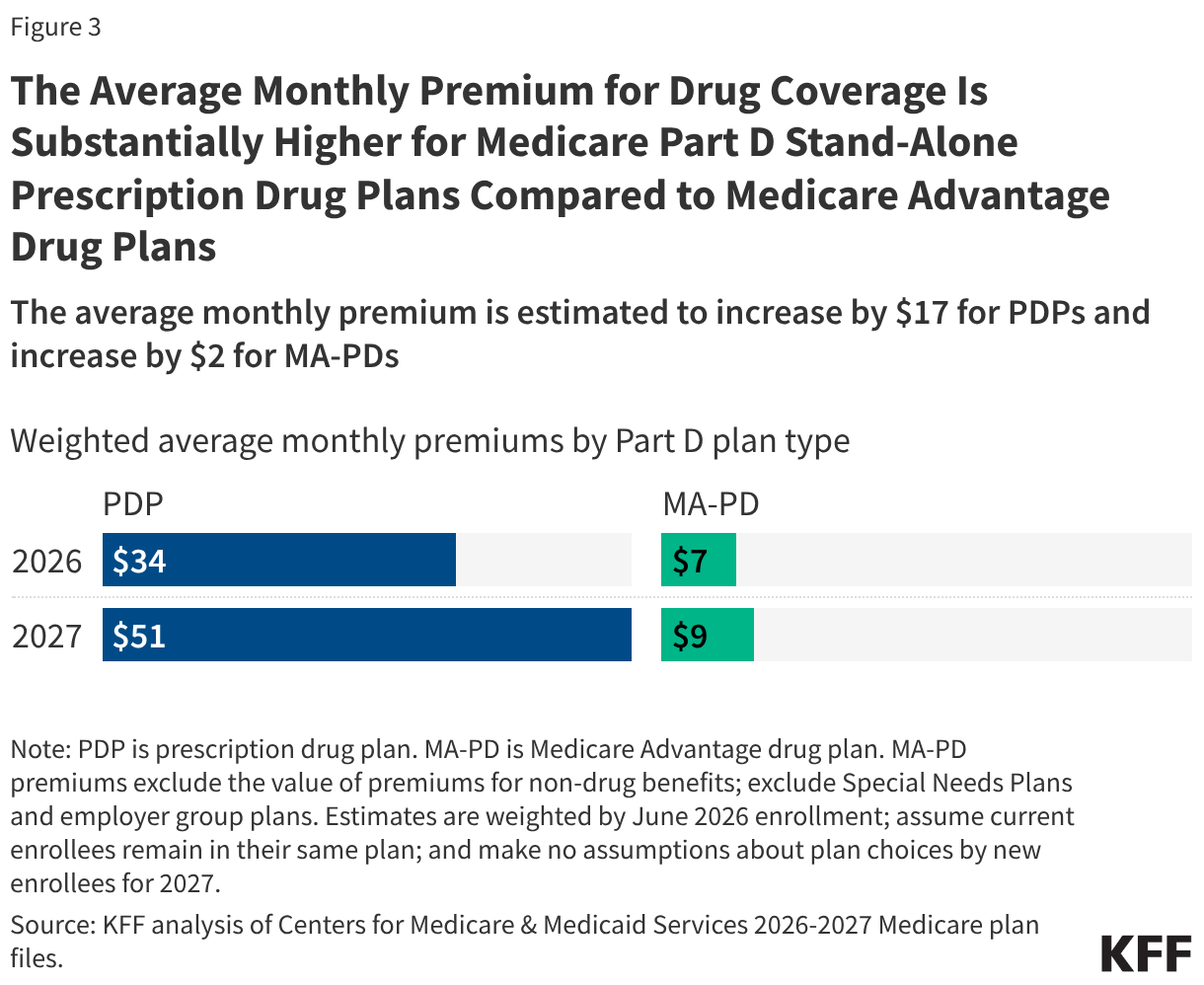
The estimated average monthly PDP premium for 2027 is more than 5 times larger than the average monthly premium for drug coverage in MA-PDs – $51 versus $9 (Figure 3). Between 2026 and 2027, the average monthly premium is increasing by $17 (50%) for PDPs and $2 (20%) for MA-PDs. MA-PD sponsors can use rebate dollars from Medicare payments to lower or eliminate their Part D premiums and offer extra benefits, but there is no equivalent rebate system for PDPs. According to MedPAC, Medicare Advantage monthly rebates per enrollee have more than doubled since 2018, from $95 to $199 in 2026, and of the $199 total monthly rebate amount in 2026, $51 was used to reduce MA-PD Part D premiums. The MA-PD premium is also heavily weighted by zero premium plans, with nearly 8 in 10 MA-PD enrollees paying no premium for drug coverage in 2026.
Three-Fourths of PDP Enrollees Without Low-Income Subsidies Will See an Increase in Their Monthly Premium in 2027 if They Make No Changes During Open Enrollment
Out of 13.6 million PDP enrollees without LIS in 2026, 10.4 million (76%) will pay a higher monthly premium in 2027 if they keep their current plan. This includes 4.1 million enrollees in PDPs that charge no monthly premium in 2026, who will pay higher premiums in 2027 because there are no zero premium PDPs available in 2027. Of the 10.4 million non-LIS PDP enrollees facing higher premiums for their current plan, 2.4 million will see their monthly premium increase by more than $50 if they stay in their same plan for 2027. Among the 24% (3.2 million) of non-LIS PDP enrollees facing a premium reduction, most (2.6 million) will see a decrease of $5 or less (Figure 4).
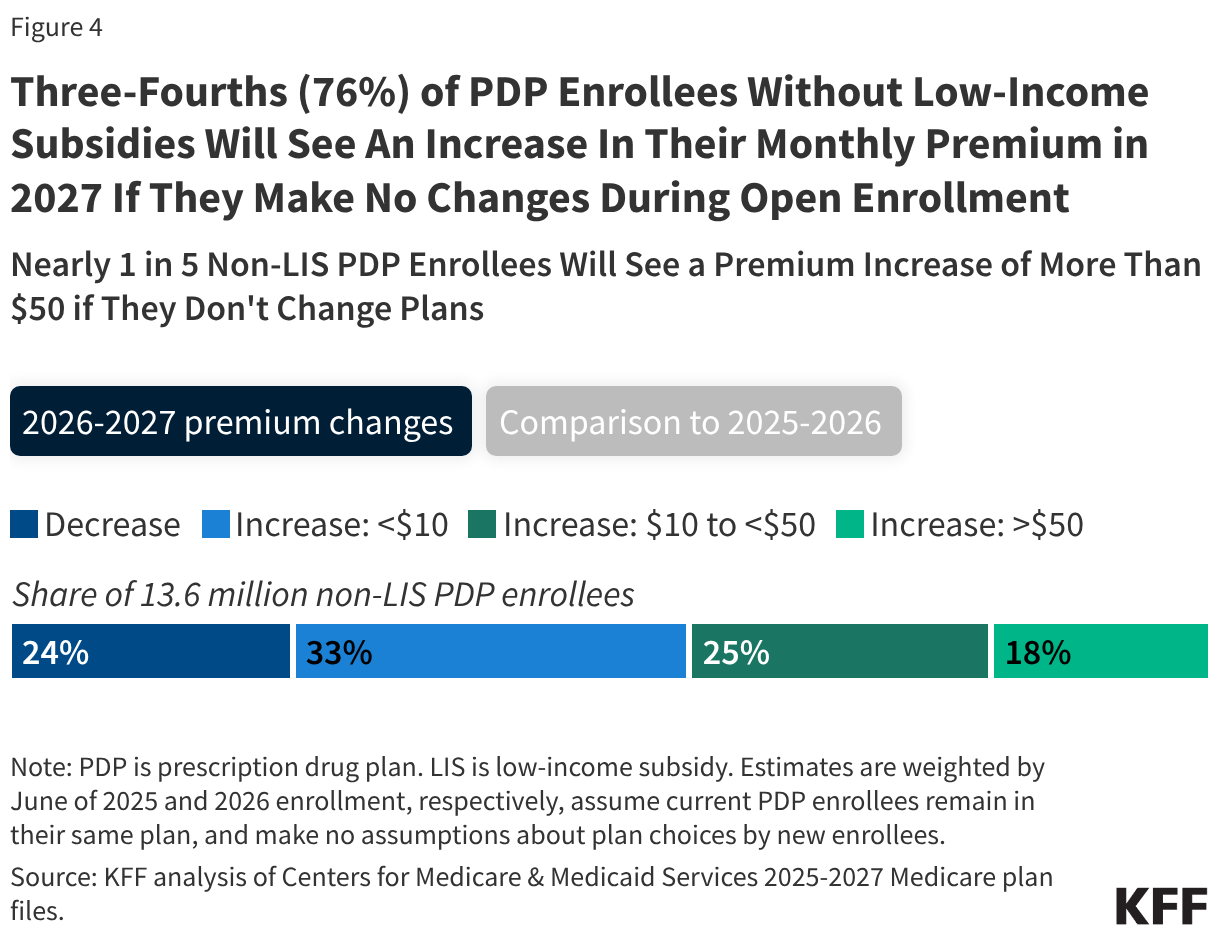
By comparison, 56% of PDP enrollees were facing a premium increase for their same plan for 2026, but less than 1% (38,000 enrollees) faced a premium increase larger than $50 per month. The Trump administration’s decision to discontinue the Part D Premium Stabilization Demonstration after 2026 ended the additional premium subsidies that were provided to PDP sponsors and the cap on the maximum allowable monthly PDP premium increase, which was set at $50 for 2026. (Monthly premiums could increase by more than $50 for PDPs that did not participate in the demonstration.)
Average Monthly Premiums for the 8 National PDPs Are Projected to Range from Around $6 to $204 in 2027
Part D premiums for 2027 vary widely across plans, as well as across regions for the same plan, as in previous years (Figure 5). Among the 8 PDPs that will be available in all 34 PDP regions in 2027, the two lowest-premium plans are Centene’s Wellcare Value Script, an enhanced PDP with an average premium of $6.50 for 2027 and Wellcare Classic, a basic PDP with an average premium of $10.90 for 2027. Both PDPs were available for zero monthly premium in many areas in 2026, but no zero premium PDPs are available in 2027. Among the most expensive national PDPs are United’s AARP Medicare Rx Preferred and Humana Premier Rx Plan, with average monthly premiums for 2027 of $204.50 and $137.40, respectively.
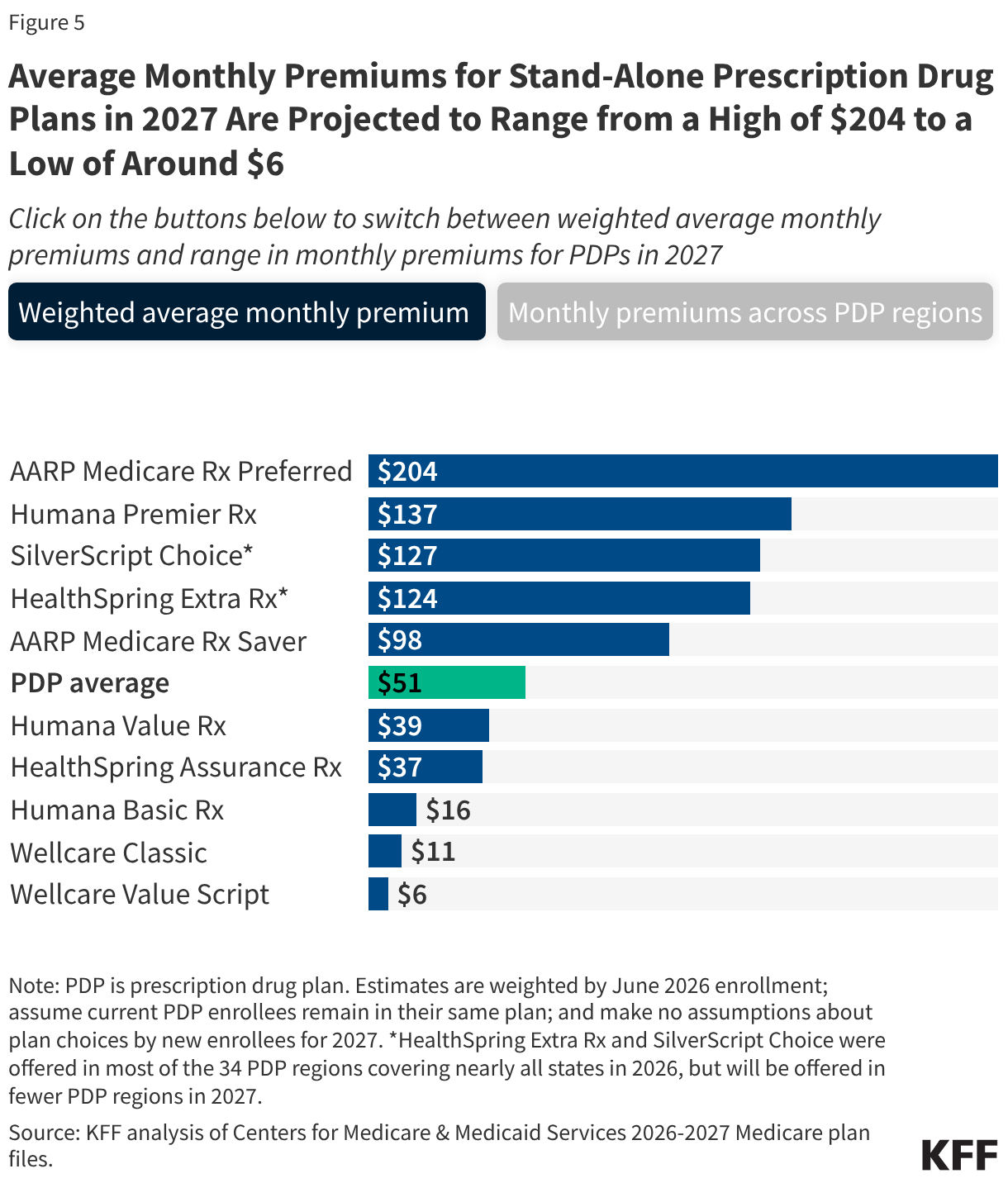
Monthly premiums for several national PDPs vary widely around each plan’s average. For 6 of the 8 national PDPs, there is a difference of $90 or more across the 34 PDP regions between the plan’s lowest and highest premiums. For example, the average monthly premium for AARP Medicare Rx Preferred is $204, but ranges from $136.70 to $264.50 across regions. The monthly premium for AARP Medicare Rx Saver averages $98 but ranges from $10.30 to $235.30 across regions. And for Humana Basic Rx, the average premium is $16 but ranges across regions from $6.30 to $169.60.
Medicare Part D enrollees in national PDPs will face a range of premium changes if they keep their current plan in 2027. Enrollees in United’s AARP branded PDPs face significant premiums increases if they don’t switch plans for 2027 – $78.50 for AARP Medicare Rx Preferred (a 62% increase) and $48.10 for AARP Medicare Rx Saver (a 97% increase) (Figure 6).
Deductibles and Cost Sharing
Most Part D Enrollees Will Pay a Drug Deductible in 2027, Including 85% of MA-PD Enrollees and Virtually All PDP Enrollees
The share of MA-PD enrollees in plans that charge a deductible for Part D coverage will increase from 80% in 2026 to 85% in 2027 if they do not switch plans. Nearly all stand-alone PDP enrollees (99.8%) will also be enrolled in plans that charge a deductible for drug coverage in 2027, up from 96% in 2026 (Figure 7). (Some enrollees in these plans receive low-income subsidies that cover their deductible.)
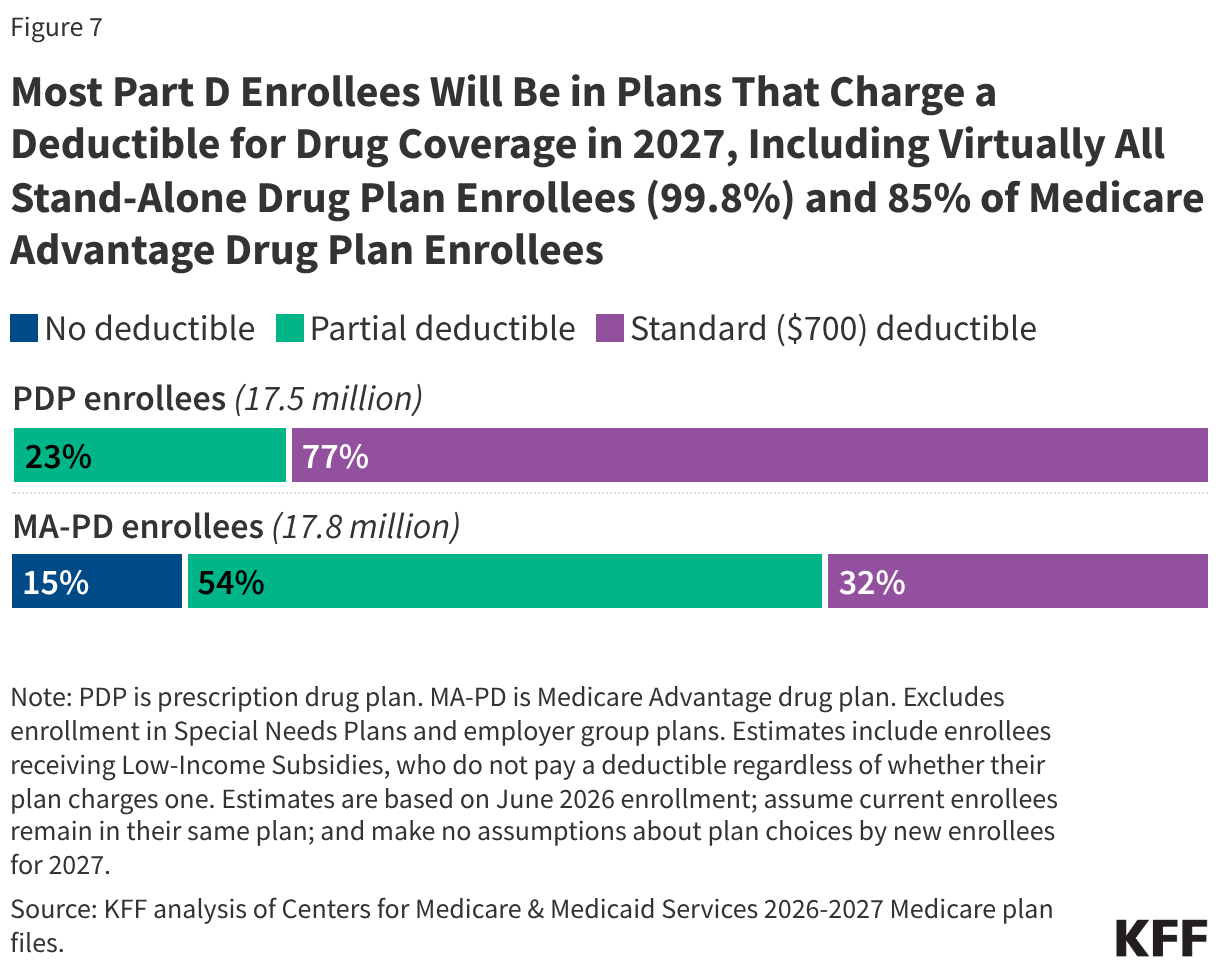
The weighted average Part D deductible in 2027 will be $643 for PDP enrollees and $489 for MA-PD enrollees (the standard Part D deductible is increasing from $615 in 2026 to $700 in 2027). Although the average Part D deductible is higher for PDP enrollees, MA-PD enrollees are facing a larger increase in the average deductible than PDP enrollees between 2026 and 2027 – an increase of $128 (36%) for MA-PD enrollees versus $103 (19%) for PDP enrollees (Figure 8).
Most Part D Enrollees Will Face Coinsurance Rather Than Copayments for Preferred Brands and Non-Preferred Drugs in 2027
Part D enrollees face much higher cost-sharing amounts for brands and non-preferred drugs (which can include both brands and generics) than for drugs on a generic tier, and most Part D enrollees face coinsurance rather than copayments for drugs on formulary tiers other than generics. Coinsurance can mean less predictable out-of-pocket costs than copayments. The typical five-tier formulary design in Part D includes tiers for preferred generics, generics, preferred brands, non-preferred drugs, and specialty drugs.
Most Part D enrollees now face coinsurance for both preferred brands and non-preferred drugs, with the share of MA-PD enrollees facing coinsurance for preferred brands increasing from 54% in 2026 to 83% in 2027, and 89% of MA-PD enrollees facing coinsurance for non-preferred drugs, similar to 2026. Nearly all PDP enrollees will face coinsurance for preferred brands and non-preferred drugs in 2027, the same as in 2026.
Among all Part D plans, median standard cost sharing in 2027 for different types of drugs is (Figure 9):
- Generics: For preferred generics, enrollees face copayments of $4 in PDPs and $0 in MA-PDs, and for other generics, copayments of $20 in PDPs and $5 in MA-PDs.
- Preferred brands: For preferred brands, virtually all PDP enrollees face a median coinsurance of 25%; 83% of MA-PD enrollees face a coinsurance of 20% and 17% face a median copayment of $47.
- Non-preferred drugs: For non-preferred drugs, which can include both brands and generics, all PDP enrollees face a median coinsurance of 35%; 89% of MA-PD enrollees face a median coinsurance rate of 29% and 11% of MA-PD enrollees face a median copayment of $100.
- Specialty drugs: Median coinsurance for specialty drugs is 25% for PDP enrollees and 26% for MA-PD enrollees.
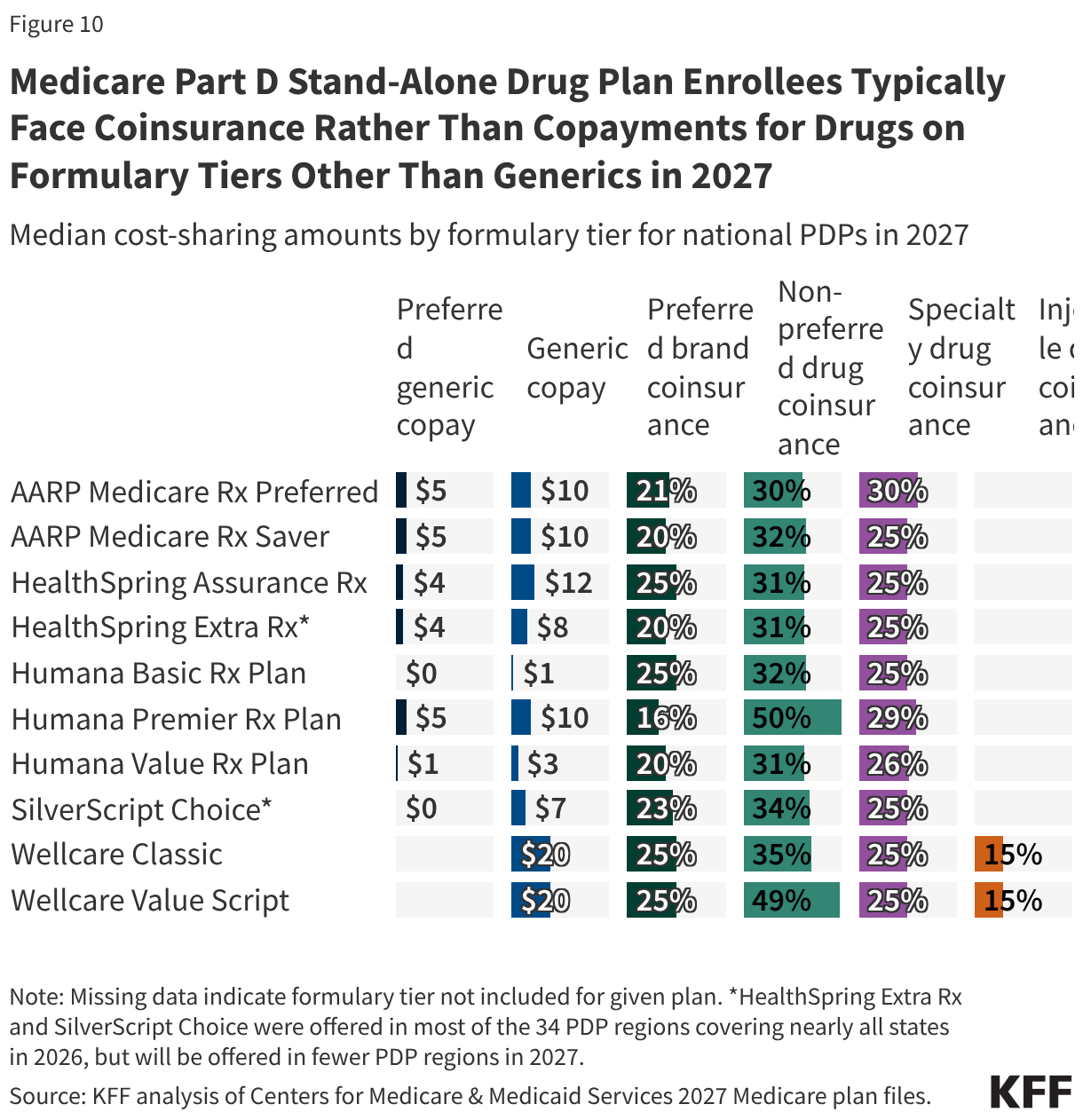
Part D enrollees in the PDPs that were available on a national basis in 2026 face median copayments ranging from $0 to $5 for preferred generics in 2027, while median copays for drugs on the standard generic tier will range from $1 to $20 (Figure 10). Median coinsurance ranges from 16% to 25% for preferred brands; from 30% to 50% for non-preferred drugs, and from 25% to 30% for specialty drugs. New for 2027, Centene has added an injectable drug tier with coinsurance of 15% and combined the two generics tiers into one for its Part D plans, with a copayment of $20 in its two Wellcare PDPs.